
Update > What Does Peaceful Political Leadership Look Like?
What Does Peaceful Political Leadership Look Like?
2026-01-06
What Does Peaceful Political Leadership Look Like?
A leader in peace is aware of the responsibility that comes with the power their position holds and acts in the best interest of the people. Rather than an interest in monetary gains or an elevated social status, peaceful political leaders are led by their inner drive to end conflict and to ensure a better future for everyone. Individual qualities that are often present in peace leaders are emotional self-control and forgiveness, empathy, optimism about change and being naturally inclined to choose reconciliation over conflict.[1]
Peaceful political leadership can take on different forms depending on the context. Former Colombian president Santos led the country to conflict resolution and a transition to peace.[2] He was a controversial leader for negotiating with opponents, but he helped to achieve the transition to peace. His success was due in large part to his personal belief system that valued the concept of reconciliation. He valued empathy and recognisedthe importance of understanding the other parties’ perspective. He remained respectful of his opponents, eventually allowing him to negotiate successfully; at the same time, he remained a strong and decisive leader, allowing him to maintain the respect of the people.[3] The example of former president Santos shows the importance of individual qualities, beliefs, skills and practices in peaceful leadership.
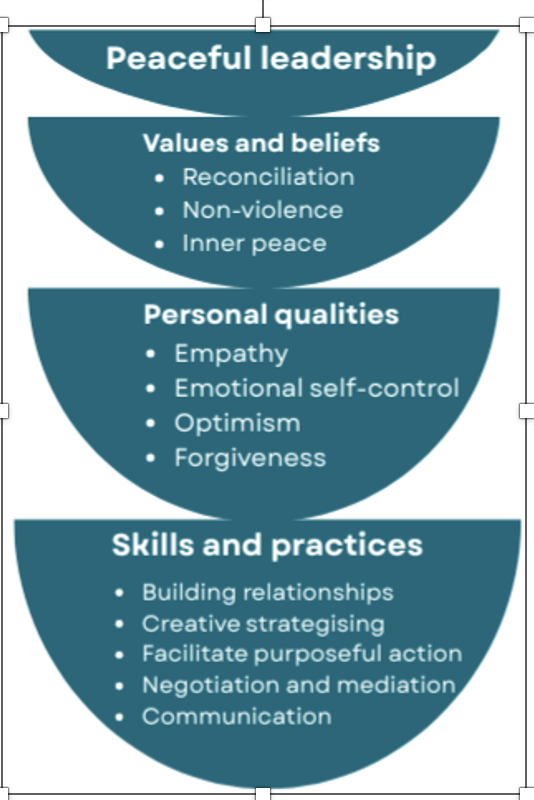
In addition to the peaceful leaders' personality traits and strong morals, they are adept at a set of skills and practices that will help them achieve their goals. These include: ’Building relationships, crafting a public narrative that facilitates purposeful action, engaging in creative strategising to challenge those with power, and catalysing action.’[4] Additionally, they have excellent communication, negotiation, and mediation skills.
Transitions to peace are not created by individual leaders alone; they are the result of the collective efforts of large groups of society, of movements. If not everyone is living in peace, no one is living in peace. True peace is not selective or regionalised; it is for everyone. Here, the importance of forgiveness becomes clear as ’everyone’ also includes old enemies.
Leaders must embody peace themselves before they can lead others towards peace. It is a collective responsibility to focus on commonalities and choose empathy over hate, but peaceful leaders set the example by leading with empathy and following principles of non-violence.[5]
Inclusion as Strategy: Women, Youth, Minorities
Inclusion is not just a strategy for peacebuilding; it is essential in order to achieve and sustain peace. Inclusion of youth, women and minorities in politics is not about placing their needs or voices above others. Rather, it is the way towards equity where differences are celebrated as they pave the path to sustainable peace, where everyone’s needs and interests are addressed.
Women make up half of the population and are the main victims of ongoing conflict as they suffer from both physical and sexual violence.[6] Their inclusion in the peace process will ensure their suffering is addressed and their needs are met. Women's participation in peacebuilding and negotiation leads to a more sustainable, durable peace. Women from different ethnicities and socioeconomic classes share similar experiences in the war. Women’s participation in the peace process can help to transcend the boundaries between different minority groups and classes, while also ensuring representatives from different groups are included.[7]
In conflict and peacebuilding, men are often seen as warriors who make strategic military decisions, while women are seen as the caretakers who do not need to be included in the political process. As these beliefs and assumptions persist, women’s mere representation in peacebuilding and politics is not sufficient. The active participation of women in politics, where they can take up space and have autonomy in decision-making, is necessary to counter these assumptions and to allow women to enact real change.[8]
Including youth in the peace process is essential for similar reasons, they are differently affected by the conflict and have different perspectives. A youth political leader explains: ”Youth should be given more space to participate in the peace process because they are the ones who are going to take the responsibilities of the current leaders in the near future.”[9] Moreover, the diverse youth often have original ideas and contributions. Youth leaders can play key roles in facilitating progressive social and political movements that benefit the peace process.[10] Youth inclusion in the peace process is key to representing their unique needs and to include their progressive ideas.
The active participation of women, youth, and minorities provides invaluable insights and contributions that facilitate peacebuilding. Peacebuilding can only be successful when different groups come together. Women, youth and minority groups are differently affected by the conflict and have unique perspectives and needs. The only way to reach sustainable peace is by creating an inclusive peace process that allows participation from women, youth and minorities.
Balancing Peacebuilding and Popular Support
Politicians have to balance making strategic decisions and maintaining popular support, as both are necessary for the best outcome and greatest chances at durable peace accords.
Popular support is an important factor for any state or political actor that has to constantly reinforce its legitimacy through democratic principles and through acting in the best interest of the people.[11] Popular peace is created when peace negotiations include locally defined needs as democratically expressed by people in the area. It lays the groundwork for durable peace and is tailored to diverse local needs.[12] For peace agreements, it is unclear whether they gain popular support because they successfully ended conflict, or if peace agreements are durable and successful because they had popular support.[13] What is clear is that popular support is an influential factor.
The grievances and experiences of victims from the war affect their opinion on peace agreements. To gain popular support, peace agreements need to adequately address the grievances of the public and the suffering that victims of violence have endured.[14] Another way to gain popular support is by forming peace agreements based on the interests and opinions of the people to create popular peace. Peace initiatives can be created with democratic principles, following the will of the people, but this may not always be possible.
Sometimes, leaders need to make compromises and negotiate peace agreements that they know might not correspond with the public’s opinion. In these cases, leaders must make a decision on how they can balance the actions they know to be right with maintaining popular support. One way to do this is by utilising the political strategy of reframing (link 5.3). To win popular support, they can frame the peace accord in a way that includes and builds on already existing beliefs in society, while also showing how it will benefit everyone in the long run.
For example, if a strong desire for peace is already present among the people, politicians only need to show how the peace accord will help to obtain peace for it to gain popular support. It is more complicated if emotions and anger are strong and people are primarily focused on a desire for revenge and territorial expansion. In that case, the political leader needs to emphasise the terms of the peace accord that include matters the people find important. For example, a renegotiation of state and conflict lines in their benefit might help the peace accord gain more popular support.
Leading in Uncertainty: Courage in Fragile Times
Leading in fragile and uncertain times requires skills and creative strategies to work with uncertainty. Leaders must be adaptive and open to continuously learn more about changing situations to better cope with fragility and unpredictability. They must cultivate trust and be able to manage risks and losses well.[15]
Fragile context and ongoing war create dangerous situations for politicians and other conflict actors. In these sensitive situations, they sometimes need to make high-risk decisions. Threats of violence and the risk of becoming targets for airstrikes or other violent attacks can inhibit political leaders and institutions in their peacebuilding and governing efforts. These security challenges and safety risks create increasing levels of mistrust. The rise in social media creates many opportunities for information sharing, and with that also comes the sharing of misinformation, which further declines trust. [16]
Good leadership in fragile times is characterised by an approach of inclusivity that represents people from all groups and societal classes. Rather than speaking about a fragmented ’young’ and ’old’ generation, find ways to speak to the generation of ’now’ and how they can be engaged as one.[17]
Navigating the threats, risks and complexities in fragile and unpredictable times, while acting in the best interest of the people, can often take great courage and a good strategic vision. Courage comes from within the body, while strategic vision and thinking are often linked to the mind. Mathematician and thinker Blaise Pascal wrote about the knowledge of the heart,[18] which may be helpful for leaders faced with the challenges of leading in fragile times. An example of when it can be useful is when a political strategy or decision involves significant risks, such as providing humanitarian aid or engaging in peace negotiations. To determine whether it is the right thing to do despite the risks, leaders can rely on knowledge of the heart. This knowledge is not explained in words, nor is it just emotional; it is an inner knowing that can be felt in the body.
Relying on and following the knowledge of the heart can take courage, as the inner knowing cannot always be proven or demonstrated by logic, but ’the knowledge of the heart is clear and certain in itself.’[19] Another example is the informal aid networks organised by people in Myanmar to provide aid to people who otherwise would not receive any. They create possibilities despite the risks because the knowledge of their hearts tells them it is the only right thing to do. Doing what you know is right is not always easy, but in fragile times, this can sometimes be the only way to achieve political goals and create a better, peaceful future.
Political Legacy: Peace You Can Leave Behind
A peace you can leave behind is formed through the beliefs and morals a leader stands by, which characterise their leadership, and through well-founded policies and institutions that can be carried over to the next generation.
When thinking of legacies of peace, Mahatma Gandhi is perhaps the most famous example. Many great names followed his principles of truth, non-violent resistance, and peace, and created their own legacies. Examples are Martin Luther King and Nelson Mandela, who were inspired by the Gandhian principles of non-violent resistance. In the struggle for democracy and human rights, Aung San Su Kyi also followed the principle of non-violence in resistance.[20]
The Gandhian principles these political legacies have in common show the importance and power of non-violent resistance in creating a political legacy. Gandhi found that pure goals, such as peace, can only be obtained through pure means. Gandhi objected to violence because any good it appears to do is temporary, but the evil it does is permanent.[21] If political leaders can successfully adopt these principles in their political strategies and adopt non-violent policies, their chances to create a political legacy of peace will significantly increase.
A legacy of peace is also created through practical means, such as well-founded institutions and policies. A few examples are transparent governing systems that build on democratic principles, a judiciary system that aligns with restorative justice, focused on healing rather than revenge, and extensive political networks that enable successors to continue open dialogue. By establishing a strong foundation of institutions and policies, and showing unwavering morals and ethics in political decisions, political leaders can set up future generations to continue on the path to peace or help them maintain a lasting peace.
A legacy of peace is created in the present. Political leaders of today can create their legacy for a lasting peace by following Gandhian principles of non-violence, truth and peace. This can look like adopting strategies of dialogue over violence, transparent governing practices and creating unity between different groups. A peace you can leave behind is recreated and maintained generation after generation. The role of political leaders is to provide the moral guidebook and a strong practical foundation for future generations to build on.
[1] McIntyre Miller, W., & Green, Z. (2015). An integral perspective of peace leadership. Integral Leadership Review, 15(2).
[2] Tappe-Ortiz, M. (2020). Political leadership for peace processes: Juan Manuel Santos between hawk and dove.
[3] Tappe-Ortiz, M. (2020). Political leadership for peace processes: Juan Manuel Santos between hawk and dove.
[4] McIntyre Miller, W., & Green, Z. (2015). An integral perspective of peace leadership. Integral Leadership Review, 15(2).
[5] McIntyre Miller, W., & Green, Z. (2015). An integral perspective of peace leadership. Integral Leadership Review, 15(2).
[6] Muwanzi, J., & Goredema, D. (2023). The relevance of inclusivity in mediation and negotiation processes: A reflection. Research and Analysis Journals, 6(7).
[7] Muwanzi, J., & Goredema, D. (2023). The relevance of inclusivity in mediation and negotiation processes: A reflection. Research and Analysis Journals, 6(7).
[8] Ćeriman, J. (2025). Women, ethnicity, and peacebuilding: A case study of the councils of national minorities in Serbia. Nationalities Papers.
[9] Grizelj, I. (2019). Engaging the next generation: A field perspective of youth inclusion in Myanmar’s peace negotiations. International Negotiation, 24(2).
[10] Alomair, M. O. (2016). Peace leadership for youth leaders: A literature review. International Journal of Public Leadership, 12(3).
[11] Roberts, D. (2011). Beyond the metropolis? Popular peace and post-conflict peacebuilding. Review of International Studies, 37(5).
[12] Roberts, D. (2011). Beyond the metropolis? Popular peace and post-conflict peacebuilding. Review of International Studies, 37(5).
[13] Dyrstad, K., Binningsbø, H. M., & Bakke, K. M. (2022). Wartime experiences and popular support for peace agreements: Comparative evidence from three cases. Journal of Conflict Resolution, 66(9).
[14] Dyrstad, K., Binningsbø, H. M., & Bakke, K. M. (2022). Wartime experiences and popular support for peace agreements: Comparative evidence from three cases. Journal of Conflict Resolution, 66(9).
[15] Hardy, M. (2022). Responding to turbulent times: Where does leadership come in? New England Journal of Public Policy, 34(2).
[16] Hardy, M. (2022). Responding to turbulent times: Where does leadership come in? New England Journal of Public Policy, 34(2).
[17] Hardy, M. (2022). Responding to turbulent times: Where does leadership come in? New England Journal of Public Policy, 34(2).
[18] Bom, K. (2012). Heart and reason: Using Pascal to clarify Smith’s ambiguity. Pneuma, 34(3).
[19] Bom, K. (2012). Heart and reason: Using Pascal to clarify Smith’s ambiguity. Pneuma, 34(3).
[20] Gupta, B. (2023). Legacy of peace: Gandhi's ideals and the global visionaries. Himachal Pradesh University Journal, 11(2).
[21] Gupta, B. (2023). Legacy of peace: Gandhi's ideals and the global visionaries. Himachal Pradesh University Journal, 11(2).