
Peace and the United Nations
The United Nations (UN) is a large organisation with peacebuilding as one of its main tasks. The peacebuilding approach, or form of peacebuilding, varies depending on the context. The UN’s role in peacebuilding can be to help conflict actors negotiate and come to an agreement through high-level diplomacy, and to monitor if all parties honour the terms after the agreement is reached. Or, the UN’s task can be to support peacebuilding programs that address the root cause of conflict and have the highest chances of achieving long-term peace.[1]
The UN recognises that sustainable peace can only be obtained if local populations drive peacebuilding, and it acknowledges the importance of localisation.[2] In practice, UN localisation efforts often take the form of local engagement within an UN-led project. This approach can be effective, but it means local actors will have to give up ownership in the project meant to benefit them. A more valuable way for UN involvement would be to support projects that are initiated and led by local organisations. This can be challenging for the UN as it is set up to lead, rather than support. Further complications arise from the UN’s approach to peacebuilding, which focuses on cause-and-effect outcomes measurable on a linear scale,[3] and its extensive bureaucratic structure that limits their flexibility. UN engagement would be most effective if it moved away from the linear approach to setting up projects with clear goals based on cause-and-effect, which do not allow for the complexities of war. In their communication with the UN, political leaders can focus on the long-term, non-linear goals of their projects, so that the UN will be made aware that they need to adopt a different mindset in assessing the outcomes and goals of the project.
While it is good to be aware of the limitations of the organisation, it is important to recognise its value as well. For example, the UN is experienced in mediations and negotiations, and in ensuring the safety of everyone involved while acting as a neutral intermediary. Before the UN can take on a role in mediation, it is important that trust is built between the UN, conflict actors, and local populations. Trust can be fostered through small efforts first, where the UN supports local initiatives or engages in collaborations that demonstrate the UN’s good intentions. Although the UN’s structure can be limiting, the organisation employs many individuals working hard to find solutions within the system. Finding the right people to communicate and collaborate with can be a good first step for effective engagement.
ASEAN’s Role in Myanmar’s Peace Process
ASEAN is an international organisation that, upon its establishment, created a policy of non-interference, allowing member states to solve internal issues on their own.[4] This is one of the principles that the ASEAN way was built on. The ASEAN way refers to the organisation’s norms of non-interference, diplomacy, and consensus in decision-making. These principles were established with respect to members’ state sovereignty. In the current changing times with increasing human rights violations, the organisation's foundational principles prove ineffective in forming a collective response to humanitarian crises. A clear example is the human rights violations in Myanmar’s ongoing civil war. Constrained by principles of non-interference and consensus in decision-making, ASEAN has failed to respond adequately, and its role in Myanmar’s peace process has been mostly non-existent.[5]
Former Malaysian foreign minister Saiffuddin said that the principle of non-interference should not imply indifference.[6] Without going against the principle of non-interference, ASEAN can take steps to express the disapproval of the junta’s actions and help to counter impunity. ASEAN engages with the junta, which is a military power, not a legitimate government. A good start would be for ASEAN to also engage with the NUG and NUCC as key stakeholders. This is especially important considering the junta has shown no interest in engaging in a reconciliation process or giving up part of its power. The chairman of the Singapore-based Institute of International Affairs spoke about the need for some channels of communication to remain open between ASEAN and the generals, but advocates for the need to engage all stakeholders and not just the junta.[7]
The ongoing human rights violations and the junta’s unwillingness to negotiate can be sufficient reasons for ASEAN to move away from its principles and consider a stronger response. Political leaders can advocate for a stronger response from ASEAN based on the junta’s human rights violations and their unwillingness to reconcile. Additionally, they can emphasise how a more adequate response from ASEAN will send the message to the international community that the organisation disapproves of the crimes committed by the junta. Rather than relying on a foundation of non-interference, the new ASEAN way could be renegotiated to create a foundation on ideas of positive peace and principles that protect human rights.
When Global Actors Get Involved: Risks and Rewards
Involvement from global actors is very common in conflicts worldwide. The involvement of global actors can bring more access to resources and reduce political risks, but it can also increase the distance between local populations and the organisations representing them.
In recent years, there has been more attention and understanding for peacebuilding initiatives built on local knowledge rather than external intervention alone. It is now understood that effective and sustainable peacebuilding should include local knowledge and require participation from local communities.[8] Local knowledge can be a misleading term because it suggests that there is a clearly defined unit of local knowledge that has only one understanding. The reality is, of course, much more complex with different perspectives and interpretations of conflict situations.
Global actors are inclined to simplify the knowledge; the bigger the organisation’s structure, the more details and complexities of local knowledge get lost as it moves up in the structure.[9] Additionally, knowledge from local people is filtered through; ideas that are aligned with already existing beliefs or plans in the organisation are more influential in decision-making than the voices that highlight the complexities.[10] A risk of global actors' involvement is that only the voices that reinforce already existing beliefs are heard, but the inclusion of the entirety of local knowledge remains absent.
Working with larger international organisations also creates a risk for smaller organisations to be absorbed into the larger structures. A close partnership can mean that local organisations have to abide by strict conditions and mandates set by the international organisation. They lose their flexibility, and the more structured the organisation becomes, the further it moves away from local populations. This can make it harder to include local knowledge and can limit the organisation’s ability to work on peacebuilding projects effectively.[11]
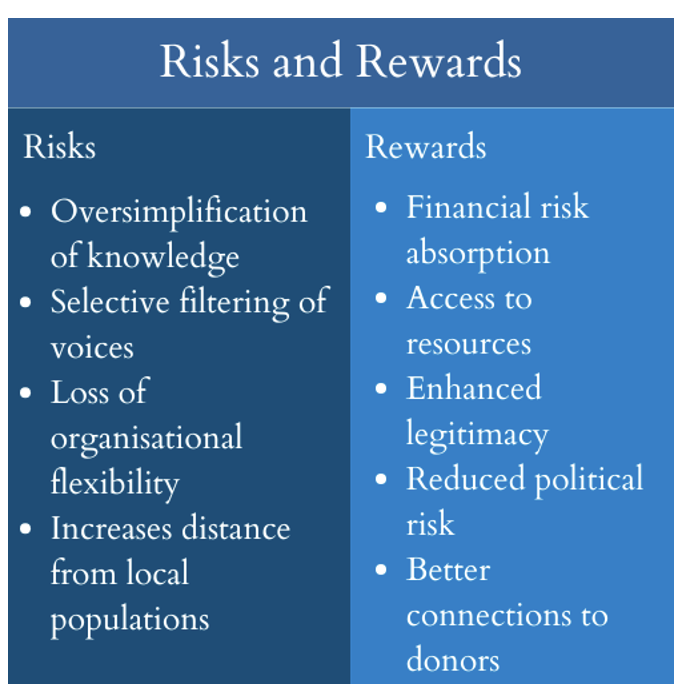
When international peacebuilding organisations can successfully take on the role of an intermediary between, for example, civil society organisations and donors, their involvement can be beneficial for local organisations. More established CSOs with a developed financial structure are more likely to receive financial aid, even though smaller organisations likely have stronger local ties.[12] International organisations as intermediaries can absorb the financial and political risks for donors as they avoid direct engagement with local actors, and support local actors through financial support and access to more resources. Partnerships with international organisations can also give more legitimacy to the local actors, which can decrease the political risks they face in their peacebuilding activities.[13]
Third-Party Mediation: What Political Leaders Should Know
Third-party mediation occurs when international organisations, countries, or individuals outside of the conflict take on mediation roles between conflict actors. Several conditions and factors influence whether third-party mediation is desired and successful. Third parties are likely to offer mediation when they have their own interests in the conflict. Examples are security interests if the third party borders the conflict region, or economic interests if the third party wants to expand or improve trade in the area, or they wish to see the conflict end for moral reasons.[14] States with strong historical linkages to the country at war are more likely to offer mediation, but the warring parties are less likely to accept mediation offers from the states with strong historical linkages, potentially because of past intervention or fear of bias.[15]
Especially in fragile democracies, negotiating requires careful consideration (link M5.4). Before accepting third-party mediation, political actors need to see the benefits of coming to the negotiation table, and they need to be willing to make concessions. Political leaders need to be open to engaging in negotiations if they are to accept third-party mediation. Conflict actors who accept mediation expect that the mediation outcome will be better than the alternative, which is to keep fighting. Warring parties are often reluctant to come to the negotiation table as they fear that disclosing too much information would expose their vulnerabilities and take away their leverage. For these reasons, opposing parties have incentives to provide misinformation or to leave information out.[16]
Third-party mediation can help to overcome the tendency to provide misinformation. When mediators have extensive knowledge of the conflict, conflict actors and past mediation attempts, third-party mediation is most likely to be successful. With extensive knowledge of the conflict’s history and the parties involved in mediation, mediators can assess for themselves whether statements made by conflict actors are dishonest.[17] If mediators think the information disclosed is inaccurate, they can challenge the actor and investigate to hold that party accountable. When conflict actors know they are being held accountable for their truthfulness, they know opposing parties will be held to the same standard. As a result, conflict actors involved in the mediation process can trust the information they receive on opposing parties to be true as well.
Working with Donors: Politics, Power, and Principles
Donors often have strategic, political, or economic interests that drive them to donate. It is important to realise this and to reflect on what a donor’s interest in the conflict might be before engaging in a partnership with them. Examples of donor motivations include expanding their political influence in the region or leveraging the donation for policy reform aligned with their interest. An economic motivation can be to open markets for more trade that would benefit the donor. Some donations are also given from humanitarian perspectives to save lives and improve conflict situations.[18] To create a win-win partnership, transparent and open communication between the donor and recipient on expectations and conditions is required. Careful consideration remains necessary for conflict actors to determine whether working with a donor is beneficial.
The effectiveness of aid is often assessed along economic indicators like growth and poverty reduction. This risks oversimplification, as it does not give adequate attention to the broader context of the conflict, with power dynamics and the impact of ongoing violence. The oversimplification can lead to donor projects that fail to engage with the conflict effectively. At the same time, not engaging with conflict dynamics allows donors to maintain influence in the region without any accountability for conflict outcomes.[19] Even when donor projects do not engage with political actors or power dynamics directly, their presence still influences the conflict setting. An example is when donor projects negatively influence local economies by overshadowing local development projects.[20]
Another important consideration when working with donors is the need to think strategically about what would happen if the donor suddenly stopped funding projects. The recent example of the stop in USAID made it clear how much the loss of a major donor can increase suffering. To strategically manage donor-dependency, it can be good to work with multiple donors. A downside to this can be that managing fragmented donations can increase administrative burdens and cause overwhelm to local actors and organisations. Different donors might have different requirements and conditions, which could lead to ineffective donor projects if these conditions are not aligned. If there are too many different donors active in the region, it increases the likelihood of overlapping aid and loss of local capacity.[21] When working with multiple donors, it is wise to consider how they could work together rather than alongside each other. This can help to navigate the downsides of fragmented donations while increasing the certainty of donation flow, knowing that when the donations from one donor come to an end, others continue.
[1] Badache, F., Hellmüller, S., & Salaymeh, B. (2022). Conflict management or conflict resolution: How do major powers conceive the role of the United Nations in peacebuilding? Contemporary Security Policy, 43(4).
[2] Badache, F., Hellmüller, S., & Salaymeh, B. (2022). Conflict management or conflict resolution: How do major powers conceive the role of the United Nations in peacebuilding? Contemporary Security Policy, 43(4).
[3] Torrent, I. (2022). Scrutinising UN peacebuilding: Entangled peace and its limits. Peacebuilding, 10(3).
[4] Morada, N. M., & Caballero-Anthony, M. (2023). Introduction to the Special Issue: Re-imagining ASEAN and the Quest for Peace—Challenges and Prospects for Peacebuilding, Conflict Prevention, and Atrocities Prevention. Journal of International Peacekeeping, 26(2).
[5] Morada, N. M., & Caballero-Anthony, M. (2023). Introduction to the Special Issue: Re-imagining ASEAN and the Quest for Peace—Challenges and Prospects for Peacebuilding, Conflict Prevention, and Atrocities Prevention. Journal of International Peacekeeping, 26(2).
[6] Saravanamuttu, J. (2025). The Myanmar crisis: Interrogating the limits of ASEAN’s constructive engagement and new pathways to peace. AEI-Insights: An International Journal of Asia-Europe Relations, 10(1).
[7] Saravanamuttu, J. (2025). The Myanmar crisis: Interrogating the limits of ASEAN’s constructive engagement and new pathways to peace. AEI-Insights: An International Journal of Asia-Europe Relations, 10(1).
[8] von Billerbeck, S., Coleman, K. P., Eckhard, S., & Zyla, B. (2024). Local knowledges in international peacebuilding: Acquisition, filtering, and systematic bias. International Studies Review, 26(4).
[9] von Billerbeck, S., Coleman, K. P., Eckhard, S., & Zyla, B. (2024). Local knowledges in international peacebuilding: Acquisition, filtering, and systematic bias. International Studies Review, 26(4).
[10] von Billerbeck, S., Coleman, K. P., Eckhard, S., & Zyla, B. (2024). Local knowledges in international peacebuilding: Acquisition, filtering, and systematic bias. International Studies Review, 26(4).
[11] Bath, C., & Gamaghelyan, P. (2024). Benefits and challenges of institutionalizing peacebuilding and activism in a post-liberal world.International Negotiation, 29(1).
[12] Lilja, J., & Höglund, K. (2018). The role of the external in local peacebuilding: Enabling action—Managing risk. Global Governance, 24(4).
[13] Lilja, J., & Höglund, K. (2018). The role of the external in local peacebuilding: Enabling action—Managing risk. Global Governance, 24(4).
[14] Greig, J. M., & Regan, P. M. (2008). When do they say yes? An analysis of the willingness to offer and accept mediation in civil wars. International Studies Quarterly, 52(4).
[15] Greig, J. M., & Regan, P. M. (2008). When do they say yes? An analysis of the willingness to offer and accept mediation in civil wars. International Studies Quarterly, 52(4).
[16] Greig, J. M., & Regan, P. M. (2008). When do they say yes? An analysis of the willingness to offer and accept mediation in civil wars. International Studies Quarterly, 52(4).
[17] Wiegand, K., Rowland, E., & Keels, E. (2020). Third-party knowledge and success in civil war mediation. The British Journal of Politics and International Relations, 22(4).
[18] Gutting, R., & Steinwand, M. C. (2020). Donor fragmentation, aid shocks, and violent political conflict. Journal of Peace Research, 57(5).
[19] Taghdisi Rad, S. (2015). Political economy of aid in conflict: An analysis of pre- and post-Intifada donor behaviour in the Occupied Palestinian Territories. Stability: International Journal of Security & Development, 4(1).
[20] Taghdisi Rad, S. (2015). Political economy of aid in conflict: An analysis of pre- and post-Intifada donor behaviour in the Occupied Palestinian Territories. Stability: International Journal of Security & Development, 4(1), 22, 1–18.
[21] Gutting, R., & Steinwand, M. C. (2020). Donor fragmentation, aid shocks, and violent political conflict. Journal of Peace Research, 57(5).