
What Is Peace in Politics?
Peace in politics is both the absence of violence and war, and the presence of social justice. The absence of violence is understood as negative peace, while positive peace is achieved when there is equality and social justice for all members of society.[1] Other characteristics that are associated with positive peace are harmony, equilibrium, and tranquillity. Ultimately, the highest goal is to achieve a peace that is sustainable and will last long-term. After negative peace, achieving positive peace is the next step on the path to sustainable peace.

Defining peace in politics can be complicated because peace has a different meaning to everyone. All politicians have a different understanding of what peace means to them. The definitions above help to understand peace and guide the movement toward positive peace and social justice, where all members have equal opportunities and access to services and resources.
Just as definitions of peace vary per person, there are different understandings of what social justice is and how to achieve it. For example, capitalism values economic freedom and individual liberty, but this is often accompanied by mass poverty and homelessness. Socialists might sacrifice individual liberties for the social and economic security of the collective.[2] These approaches have different benefits and disadvantages; there is no single right answer to how to achieve social justice, but striving for social justice is crucial for sustainable peace.
Peace in politics is interconnected with everyday peace, a peace that members of society experience in their everyday lives. Living peacefully within a community is only possible when the community itself is at peace. Including social cohesion in the definition of peace in politics is important because social cohesion is vital for members of society to experience peace in their everyday lives. Peace can only be sustainable if it is present in all levels of society.
The path towards sustainable peace is a collaboration between politicians and members of society. With their control of military operations and armed groups, political institutions have a primary role in achieving negative peace. To achieve positive peace, political organisations carry the responsibility to create political institutions and services that offer equal opportunities to all members of society, and to foster a social climate that encourages non-violent conflict resolution. This political stability provides the environment members of society need to live according to the values of acceptance and respect, which in turn will help to shape a peaceful society. “Only by ensuring the security, safety, and well-being of other people can we hope to secure our own security, safety, and well-being.”[3]
Peace Isn’t Passive: It Requires Power
Achieving peace requires power, and only with continuous effort can peace be maintained. The first step towards peace is the cessation of violence. Politicians have several tools to de-escalate and end violence. Classic strategies to end war and violence are disarmament, demobilisation, and reintegration (DDR) and security sector reform (SSR).[4]
Disarmament
Disarmament is the structural collection and destruction of weapons and requires all armed groups to give up their weapons. Political leaders can use their authority to start and manage this process.
Demobilisation
Demobilisation refers to recalling armed groups and preventing them from continuing to engage in active combat. Political leaders must initiate this process as they have the power to recall military troops and cancel operations. At the same time, the groups themselves must be willing to comply and be motivated to demobilise. Additionally, popular support will help to facilitate the processes of demobilisation and disarmament.
Reintegration
Reintegration happens when soldiers come back from war and have to reintegrate into society. The transition from soldier to civilian can be difficult. On top of that, the mindset and the experiences from being in active combat for an extended period of time may have resulted in trauma, which can complicate it further. Additionally, some communities may be faced with the return of soldiers who harmed members of their own community. This is where transitional justice is important.
Security Sector Reform
The processes of DDR are very sensitive and can be difficult to navigate for the population and political leaders. Security sector reform can help to facilitate these processes. SSR is about reshaping security institutions, increasing accountability, and aligning with human rights. An example of SSR is establishing a judicial system that will end impunity and will learn perpetrators that their harmful actions are not without consequences. The goal of SSR is to establish institutions that will serve the population and uphold the values of justice and equality.
SSR and DDR are helpful processes in the transition from war to peace. DDR must go hand in hand with dialogue and negotiations because armed actors will not give up their weapons if they feel that the need to protect themselves and their people persists. At the same time, demobilisation shows good faith in peace negotiations and dialogue. Executing DDR and SSR requires power; this illustrates how peace requires power. The power to influence is another way that peace requires power. This is elaborated on in Who Drives Peace, People, Politicians or Both(link).
Types of Peace Political Leaders Should Know
The different forms of peace that political leaders should know are positive and negative peace(link), different forms of hybrid peace governance, interpersonal peace, and inner peace. Three different forms of hybrid peace governance are important to understand.[5]
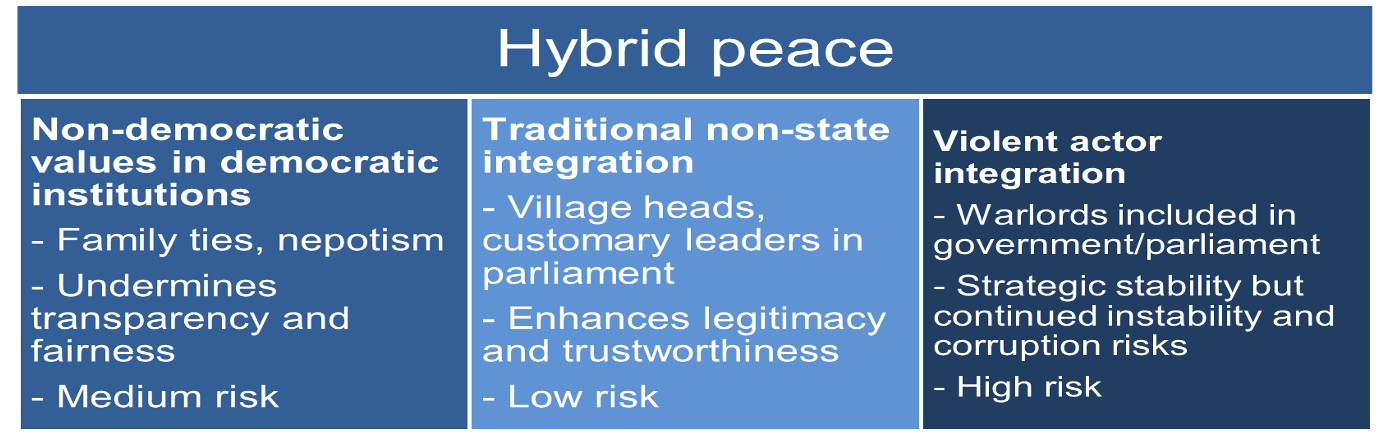
The first form occurs when, within democratic institutions, choices are not based on democratic principles, but on values such as family ties. When this happens, it can undermine the transparency and perceived fairness of the institution.
The second form of hybrid peace governance is when traditional non-state structures are combined with formal state structures. For example, village heads are included in the parliament. This form of hybridity can benefit the legitimacy and trustworthiness of an institution.
The last form of hybrid peace governance is the integration of violent non-state actors into parliament. Of course, this is not the most desirable form of governance as it risks continued instability and corruption. In some cases, however, integrating warlords into the government is the best strategic choice. If warlords or other violent actors hold significant power in a region but lack representation in a new political system, this can incentivise them to fight against the new government and attempt to overthrow it.
Other forms of peace that are important for political leaders to understand are forms of peace that go beyond political definitions. For example, interpersonal peace.[6] This peace refers to harmony and mutual respect in personal relations. Interpersonal peace within a society is vital to achieving positive peace.
Another impactful form of peace is peace of mind, peace within. To achieve and sustain positive peace, leaders must be able to act and make decisions with a clear and calm head. Having peace within themselves allows leaders to lead effectively and to make wise decisions. It is important for political leaders to know what their intentions are as leaders. This enables them to know which choices to make to best serve the people they govern. Knowing how to find peace within allows leaders to align choices and intentions more easily.
Myanmar’s Peace Landscape: What You Must Understand
One of the most important things to understand about Myanmar’s peace landscape is that peace efforts are happening both on the political level and on the ground. Peace can be a sensitive subject. For the safety of everyone involved, dialogues happen at a low profile and informally. Different mentalities in different states and regions across the country and the varying motivations of different conflict actors also create challenges. Understanding what might motivate different conflict actors can help navigate the complexities of Myanmar’s peace landscape.
In conflict, actors are often motivated by greed or grievances.[7] Ongoing conflict and instability create conditions for people to act out of greed and to pursue more power and territorial control. At the same time, an ongoing war creates more illegitimate opportunities to make money, such as corruption or even extortion. Historically, the deprivation of basic needs for ethnic minorities has created lasting grievances that still influence the conflict today.[8] Following this, the fulfilment of basic needs becomes a necessity for peace. Moreover, providing basic needs for different groups equally builds trust, as it is an indication that grievances are acknowledged and efforts are made towards sustainable solutions.
There are different phases and strategies in peace processes, and these should be adapted to different conflict contexts. Fulfilling basic needs can be primarily important in one area, while in another area, more dialogue would be the most beneficial next step. What you must understand about Myanmar’s peace landscape is that peace efforts come in different shapes and forms, and all the different peace efforts work together to build peace. Peace efforts include equal provision of services, disarmament, dialogue, and negotiations. The conscious decisions to choose acceptance and non-violent solutions, and a change in attitude, can also contribute to peace. Although peace efforts are not always visible, they are always impactful
An example of how small efforts can contribute to peace are the informal aid networks that provide support to groups and individuals who otherwise would not receive any aid.
Another clear example of the impact a change in attitude can have is the shift in the understanding of transitional justice. Transitional justice is often understood as a need for revenge. Wanting to respond to violence and suffering with violence and suffering is understandable, but this will only lead to a vicious cycle of violence. The shift in transitional justice is to understand it as healing instead of revenge. Healing is needed for a society to move forward as a whole.
Who Drives Peace: Politicians, People, or Both?
Both the people and the politicians drive peace. Everyone has the power to drive peace in every decision they make. Politicians and local leaders set examples with the choices they make; they can choose revenge, or they can choose to look for non-violent solutions. In their leadership, they have the power to choose strategies that are aligned with sustainable peace and move away from war mentalities. These same considerations can be made by people on the ground. In their interactions with others, they can choose to replace hate and resentment with compassion and acceptance. Driving peace is a collaboration between politicians and the people. When their values are aligned, they will drive peace together.
Politicians can influence the attitudes of the public.[9] Being aware of this gives them an opportunity to drive peace through the influence their decisions and actions have on the attitude of the public. When leaders adopt an attitude of acceptance towards differences and search for non-violent conflict resolutions, they will see these values reflected in a more harmonious society as people follow their example.
Emotions play a key role in politics. They affect the decisions politicians make, influence how public opinions are formed, and affect preferences in policy decisions. For example, anger leads to a preference for more aggressive policies.[10] When the public receives information about choices and policies made by politicians, this can affect their attitudes towards the matter. If politicians act out of anger and respond to violence with more violence, this anger will be carried over to the people. The attitude of anger will be reflected in the behaviour of the people, and lead to more hostilities. Leading with hate and resentment towards others will reflect in more hate and resentment in society and will cause people to be more mistrusting and hostile towards people from other groups.
More strategies that help politicians to drive peace are discussed in Peace isn’t Passive, it Requires Power(link). In the articles What is Peace in Politics(link) and Types of Peace Political Leaders Should Know(link), elaborate on how Peace can be understood in political terms and in terms that go beyond political understandings. Driving peace is a complex process that requires the collaborative effort of people and politicians.
[1] GALTUNG, J. 1969. “Violence, Peace, and Peace Research.” Journal of Peace Research 6 (3): 167–91.
[2] Barash, D. P., & Webel, C. P. (2021). Peace and conflict studies (5th ed.). SAGE Publications.
[3] Murithi, T. (2009). The meaning of peace and its connection to reconciliation. In R. David (Ed.), Peacebuilding, healing and reconciliation: An analysis of unseen connections for peace (pp. 3–16). Nairobi: Pauline Publications Africa.
[4] DCAF. (2020). SSR and DDR in peace agreements: Thematic brief. Geneva: Geneva Centre for Security Sector Governance. Retrieved from DCAF publication archive
[5] Belloni, R. (2012). Hybrid peace governance: Its emergence and significance. Global Governance, 18(1), 21–38.
[6] Barash, D. P., & Webel, C. P. (2021). Peace and conflict studies (5th ed.). SAGE Publications.
[7] Keen, D. (2012). Greed and Grievance in Civil Wars
[8] Azar, E. E. (1990). The Management of Protracted Social Conflict. Theory and Cases. Aldershot: Darthmouth.
[9] Matsubayashi, T. (2013). Do politicians shape public opinion? British Journal of Political Science
[10]Sirin, C. V., Villalobos, J. D., & Geva, N. (2011). Political information and emotions in ethnic conflict interventions. International Journal of Conflict Management, 22(1), 35–59.